




Memorandum for the NCES Review Tracking System (RTS) IPEDS Data Collection Cycle
 Download the memo (516 KB)
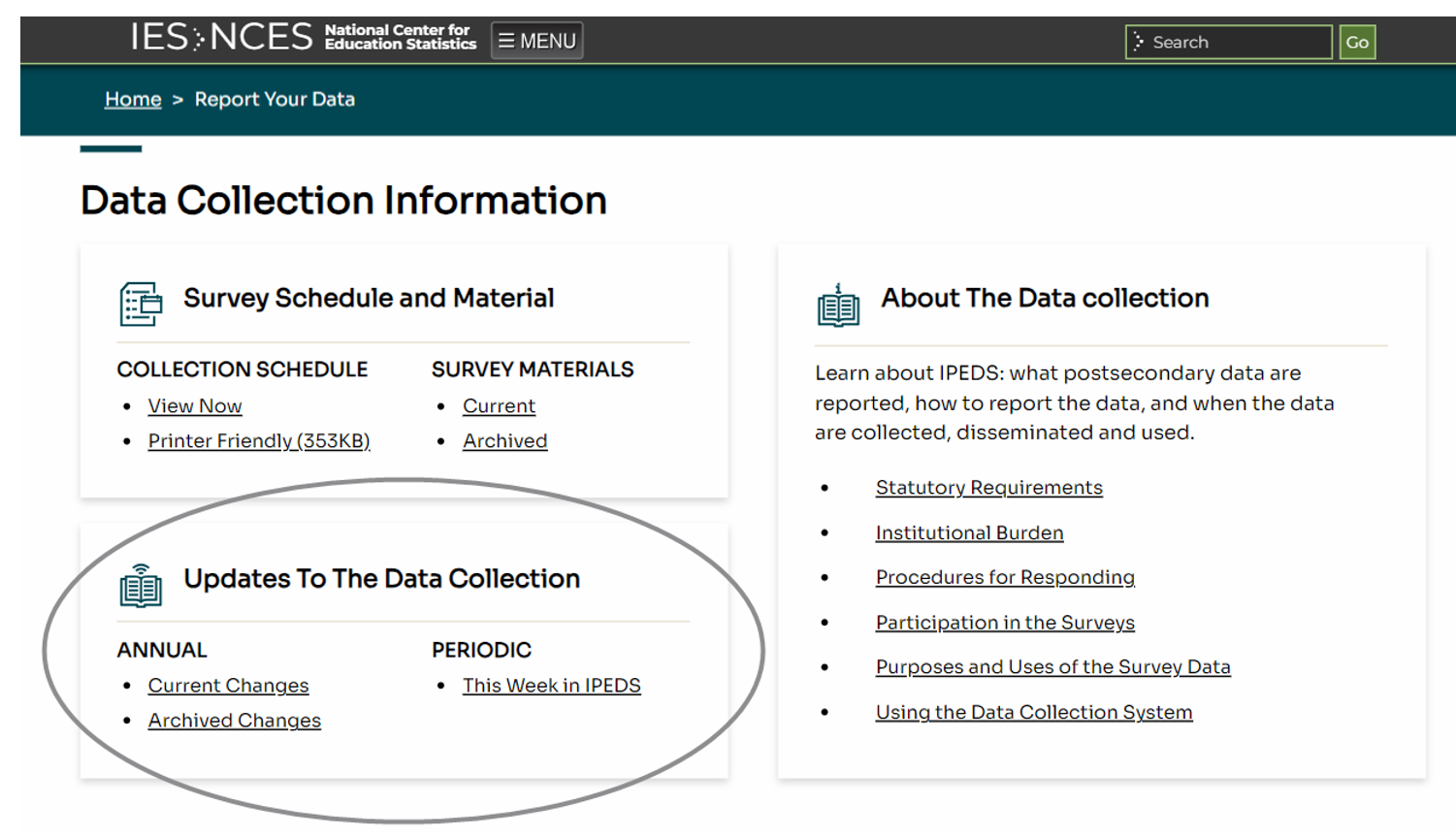
The provisional data release of the components collected during the spring collection period of the 2024–25 Integrated Postsecondary Education Data System (IPEDS) contains substantive changes in file structure or file documentation for multiple components of IPEDS compared to the previous year. In the Human Resources (HR) component, the most notable change was the removal of references to new hires from the instructions for degree-granting institutions with fewer than 15 full-time staff and for non-degree-granting institutions. Additionally, guidance was clarified to indicate that full-year salaries should be reported, even if the employee did not work the entire year. The Fall Enrollment (EF) component also saw instructional updates. Specifically, the term “non-first-time” was removed from survey screens and instructions related to “transfer-in” student enrollment status, in order to clearly distinguish between the two concepts. Clarification was provided for four-year degree-granting institutions with bachelor's cohorts to report first-time bachelor’s cohort retention rates. Specifically, students from the fall 2023 cohort who completed their bachelor's degree by fall 2024 should be counted as retained. Additionally, for degree-granting institutions in the EF component, instructions were updated to specify that high school students enrolled in college courses for credit should be excluded from calculations of the institution’s entering class. Also, the “Gender unknown” and “ Another gender” question was revised to improve clarity. In the Finance (F) component, language related to scholarship and fellowship expenses was slightly revised to clarify that student loans or private awards—where the institution holds the funds but does not select the student recipients—should be recorded as balance sheet transactions rather than as revenues or expenses. Additionally, references to “State Student Incentive Grants” (SSIG) were updated to reflect the current term: Leveraging Educational Assistance Partnerships (LEAP). Details regarding these changes can be found under “Updates to the Data Collection” on the IPEDS Report Your Data website (https://nces.ed.gov/ipeds/report-your-data#updates-to-the-data-collection), as pictured below.
The data are released to the public through the “Use the Data” portal (https://nces.ed.gov/ipeds/use-the-data) on the IPEDS website. The IPEDS Survey Methodology is located at https://nces.ed.gov/ipeds/survey-components/ipeds-survey-methodology as a resource for data users.
IPEDS is an annual, large-scale, web-based survey that collects institution-level data from postsecondary institutions in the United States (50 states and the District of Columbia) and other U.S. jurisdictions.1 For more information about the IPEDS Survey, its 13 components, and data release procedures, visit https://nces.ed.gov/ipeds/use-the-data/survey-components. This memorandum documents the IPEDS universe of reporting institutions and response to the spring collection period of the 2024–25 IPEDS, which was open from December 4, 2024 to April 2, 2025.
2024–25 IPEDS Universe of Institutions
The IPEDS universe is established during the fall collection period. During the 2024–25 collection year, there were 5,829 Title IV institutions, administrative offices2, and U.S. service academies3 in the United States and other jurisdictions of the United States, such as Puerto Rico. For 2024–25, a total of 533 postsecondary institutions were reported exclusively by a parent institution and are not included in the universe counts. The four U.S. service academies that are not Title IV eligible are included in the IPEDS universe because they are federally funded and open to the public.
NCES statistical standards require that the potential for nonresponse bias for all institutions be analyzed for sectors for which the response rate is less than 85 percent. Because response rates were nearly 100 percent for each survey component, no such analysis was necessary.
Table 1 provides an overview of the number of institutions responding to the components that comprise the fall, winter, and spring collection periods. This table is updated after each collection period’s data release. Appendix A provides a summary of responses for the previous collection year for comparison purposes. Appendix B shows a table of institutions with a Title IV status change.4 Of the 103 institutions that were Title IV in 2023–24 but were no longer Title IV in 2024–25, some 63 were private for-profit institutions.
Table 1. Summary of response by IPEDS survey component, 2024–25 data collection
| IPEDS survey component | Number of institutions | |||
|---|---|---|---|---|
| Not required to report 1 | Expected to respond | Did not respond 2 | Provided data | |
| Fall collection period: September 4, 2024 to October 16, 2024 | ||||
| Institutional Characteristics | 0 | 5,829 | 4 | 5,825 |
| Completions 3 | 0 | 5,760 | 6 | 5,754 |
| 12-Month Enrollment 3 | 11 | 5,749 | 5 | 5,744 |
| Winter collection period: December 4, 2024 to February 5, 2025 | ||||
| Admissions 3 | 3,825 | 1,935 | 1 | 1,934 |
| Graduation Rates 3 | 587 | 5,173 | 10 | 5,163 |
| 200 Percent Graduation Rates 3 | 951 | 4,809 | 6 | 4,803 |
| Outcome Measures 3 | 2,212 | 3,548 | 5 | 3,543 |
| Student Financial Aid 3 | 25 | 5,735 | 8 | 5,727 |
| Cost 3 | 5 | 5,755 | 4 | 5,751 |
| Spring collection period: December 4, 2024 to April 2, 2025 | ||||
| Academic Libraries 3 | 1,908 | 3,852 | 2 | 3,850 |
| Fall Enrollment 3 | 10 | 5,750 | 13 | 5,737 |
| Finance | 3 | 5,826 | 18 | 5,808 |
| Human Resources | 5 | 5,824 | 11 | 5,813 |
Definitions for terms used in IPEDS may be found in the online glossary located at https://surveys.nces.ed.gov/ipeds/public/glossary. The glossary is primarily focused on terms used in the current IPEDS collection and may not reflect the definitions in effect when the data in this table were collected.
For any questions related to this data product release, please contact Brian Fu (Brian.Fu@ed.gov).